Out of the Construction Crisis
The Making of a Systems-based Building Team
Autodesk Revit dominates the Building Information Modeling (BIM) scene. It is a remarkable and exciting technical and process innovation that should have helped sparked a productivity surge throughout the building process. Revit, however, provides little measurable productivity improvement for those it intends to serve –designers, builders, and trade contractors. For lack of a system of structured data, Revit provides only a shadow of its potential. Most builders and trades still resort to manually taking off and re-taking off the myriads of thousands of data entities per project – unnecessarily wasting millions of man-hours every year.
Thanks to Mary Free Bed Rehabilitation Hospital, a technical breakthrough has been successfully tested to standardize, integrate and automate the owner’s business case, budgeting, programming, equipment planning, design, and cost estimating.
Today, more than 90% of design and construction effort is non-value-added – either waste or supporting activities. The way becomes clear to reducing non-value-added effort by 20, 40, or 60 percent. Let’s take a closer look at how this is possible.
Building CATALYST plus Autodesk Revit
Building CATALYST replaces our manual, one-off, reinvent-the-wheel mindset, with a highly automated system in planning and cost management. Autodesk Revit, when placed in a CATALYST-based system, will accomplish the same for estimating, scheduling, purchasing, supply management, site logistics, closeout, and facility management.
Figure 1 depicts how a Catalyst + Revit technology system consolidates the total planning, design, supply, and construction process.
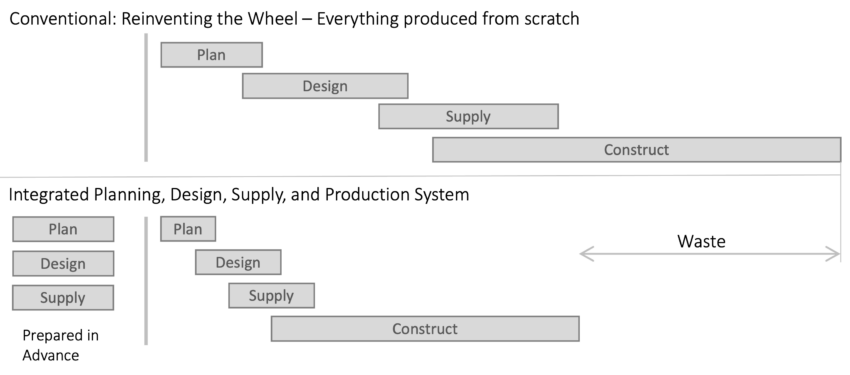
Figure 1 – System Prepared in Advance
Standardization from the Room Object
Buildings are customized creations made up of mostly standardized components: rooms, finishes, services, products, assemblies, and so on. Moving away from the one-off, reinvent-the-wheel-on-every-project approach requires standardization at the component level. Figure 2 illustrates this with an object-oriented database solution – dRofus Data Management. In the case of a typical patient room, everything associated with that room can be organizes and defined in the database. If all upstream and downstream data is submitted to a consensus One Data System – a full end-to-end data/tech system connects the early planning to purchase order for the building products or owner equipment.
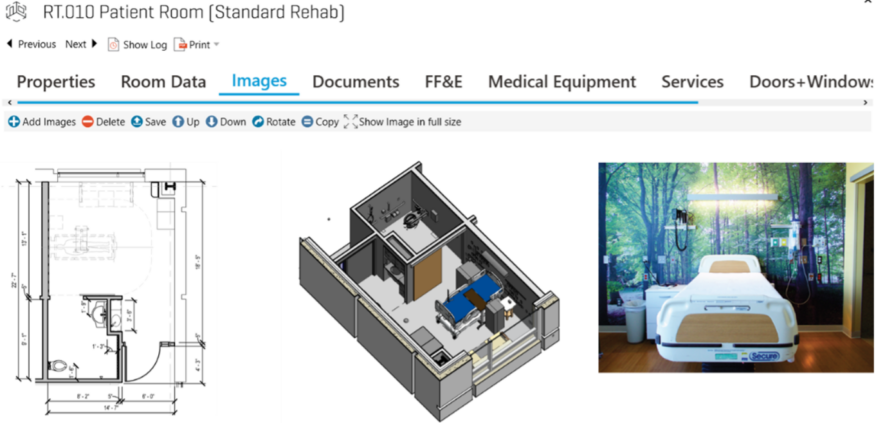
Figure 2 – Patient Room Template
It may be that a few (Pareto) standard Patient Room templates could substantially define most of the patient rooms across the country. The same could be for dozens of other room and space types. Likewise, similar standardization strategies can easily be developed for foundation, frame, enclosure, and service components and assemblies.
We have discovered how objective knowledge is acquired through the nucleus of critical data (including Uniformat Level 2.5) via Building CATALYST. Those familiar with Building CATALYST have experienced the power of knowledge and automation. Project outcomes can be known and guided to more certain results – and done so in a fraction of the time that our conventional siloes and manual approaches take.
We can take that power of knowledge and automation to the next level. We do so by expanding from data parents to children (i.e., Uniformat Level 3.5+) through downstream data/tech solutions, for programming, design, estimating, purchasing, contract management and accounting as shown in Figure 3.
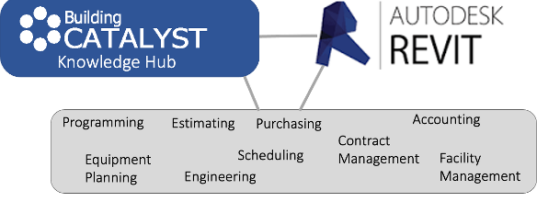
Figure 3 – Core Tier 1 Technology Integration
Building CATALYST and Autodesk Revit working together provide the main platform for all other data/tech solutions to integrate with. It doesn’t matter what combination of commercially available, or custom-developed, tools are applied if they submit to the consensus structured data standard.
Thanks to Mary Free Bed Rehabilitation Hospital the data and technology platform for this Tier 1 Production Process Improvement System was successfully piloted. Essentially it expanded the data scope from the Building CATALYST “Critical Data” to the multi-application “Detailed Data” – as described in this page: ONE DATA SYSTEM – Detailed Data
With an engaged owner, any motivated and equipped design and build team can start this journey at any time – on their own – based on precepts and content provided throughout this site. One key to success is the Win-Win Contracting method – and advanced form of Design/Build – that is supported with a data research study from completed projects from multiple sources. This data research provides the impartial valuation of cost and time, from which to measure process improvement in terms of waste removal in time and cost.
A consortium of leaders representing the owner, designer, and builder would work together to flush out and fine tune all the data standards and structures.
___________________________________
This short essay: Be Transformed by the Renewing of Your Mind describes Deming’s management philosophy as applied to the construction process, and two seminal Deming concepts: The System of Profound Knowledge and the 14 Management Points.