Out of the Construction Crisis
Be Transformed by the Renewing of Your Mind
W. Edwards Deming was the statistician and physicist credited with the lean manufacturing movement and Toyota Production System. He transformed manufacturing by changing management thinking and philosophy – from one that optimized self-interested people and groups – to one that optimized the whole. You can learn more about his background in the About page.
The primary objective for this essay is to help raise up a generation of systems thinkers to lead construction out of its cost and productivity crisis. This is possible by adopting and applying Deming’s management philosophy to the building process. As you will see throughout this website, the technical infrastructure is in place to replace our archaic structures with advanced ones that support the implementation of Deming management philosophy to construction. All that’s needed is for leaders to rise up from the owner and building productions sides.
With over 90% of all project related effort being non-productive1 – either support or waste – the opportunity to eradicate waste – and achieve a Deming Win-Win solution – is enormous.
Deming packaged his message in two ways – The System of Profound Knowledge and The 14 Management Points. Let’s review both as they apply to construction.
The Deming System of Profound Knowledge
Deming is succinct, “Lack of knowledge, that is the problem.” All of construction problems are due to lack of knowledge. Deming’s System of Profound Knowledge provides the answer.
Dr. Barbara Berry provides a helpful and short essay on Deming that applies to manufacturing, baseball, or construction, “There is a Relationship Between Systems Thinking and W. Edwards Deming’s Theory of Profound Knowledge”2. In it she writes,
“Deming’s theory of profound knowledge is a management philosophy grounded in systems theory. It is based on the principle that each organization is composed of a system of interrelated processes and people which make up system’s components. The success of all workers within the system is dependent on management’s capability to orchestrate the delicate balance of each component for optimization of the entire system. Deming believed profound knowledge generally comes from outside the system and is only useful if it is invited and received with an eagerness to learn and improve. A system cannot understand itself without help from outside the system, because prior experiences will bias objectivity, preventing critical analysis of the organization. Critical self-examination is difficult without impartial analysis from outside the organization.”
This theory includes four interrelated lenses to view the world simultaneously:
· Appreciation for a System
· Theory of Knowledge
· Knowledge of Variation
· Psychology of Change
Though these may seem heady, once you grasp the idea that construction can be submitted to a system or system-of-systems then each of these will ring of truth and makes perfect common sense.
Appreciation for a System
Buildings, and the building process, are a complex system of systems. Without a sophisticated data processing solution – construction cannot submit to the management philosophy and systems approach that transformed manufacturing. Now, with the new data processing solution, Building CATALYST, the complex can be made simple and can be submitted to Deming’s system.
Deming defines a system as, “a network of interdependent components working together to accomplish the aim of the system.” As buildings became more complex in the last century, construction evolved into a bad system. That’s because the components were never placed in relationship to the aim of the system – that is the facility purpose.
Figure 1 shows the building system – a network of components working together to accomplish the facility’s purpose with a system of critical data. The goal is to find and apply the fewest (Pareto) critical components that provide the greatest objective knowledge and insights.
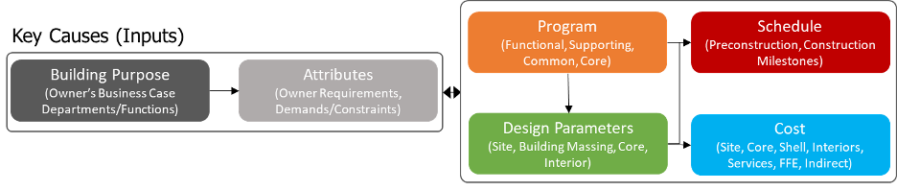
Figure 1 – Deming System for Buildings – Network of Critical Data
Each of these component groups also has a system that feeds into this master system of critical data. Functions (e.g., king beds, chemistry class lab, endoscopy surgery, MRI) are the most important components that integrate the facility to the owner’s business case. Functions are organized by department or business units (e.g., guest rooms, academics, surgery, radiology). Figure 2 shows the purpose hierarchy for a hospital.
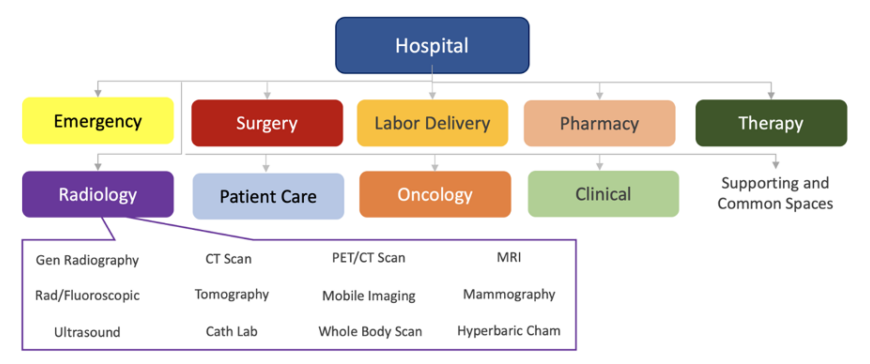
Figure 2 – Example Business Case (Hospital Radiology)
There are other component groups called attributes that dramatically impact project outcomes in the form of constraints, standards and/or requirements. These include location, construction start, number of levels, owner type, construction type, quality class, environment / energy standards, and several more.
A general hospital system is very different from a rehabilitation hospital system. Although some similarities exist between these two types of hospitals (i.e., patient beds and clinical areas), the variations are extraordinary. For example, the surgery, emergency, and radiology departments are substantially higher in scope and cost intensity than the therapy (open gym) spaces which make up an important part of the hospital rehabilitation program. A general hospital will cost a third to half-again more than a rehabilitation hospital per gross area.
None of today’s conventional data, technology, or process platforms recognize or apply the facility’s functions. That is true for planning, budgeting, space programming, design, estimating, procurement, or process improvement. Until a Deming System is in place across all data and information sources – there is no way to solve our dilemma. That’s why Building CATALYST has been created.
Theory of Knowledge
Deming taught that process improvement depends on objective knowledge acquired through continuous study of the system, including how each component interacts with each other and, ultimately, their collective impact on final outcomes. Since construction has never developed a system, as noted above, it has never had a way to study the building as a system. Construction is far too complex for any kind of manual calculus to support such a study.
William Shewhart developed, and Deming applied, a cycle for learning, developing new knowledge, and process improvement. This cycle, also referred to as the scientific method has four parts: Plan, Do, Study, Act. Figure 3 shows how we have applied this cycle in search of knowledge about construction to reliably predict and steer a facility’s program, scope, schedule, and costs.
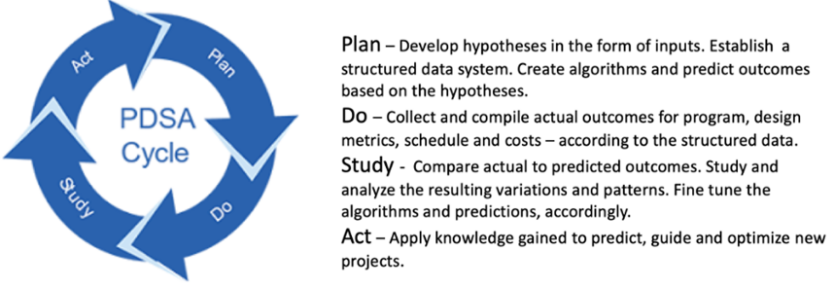
Figure 3 – Deming/Shewhart PDSA Cycle
As completed project data is entered into the CATALYST data pool the study part of the PDSA cycle is repeated. This operation involves querying across different combinations of attributes and studying the nature of the actual results to the predictions – not just for costs, but for program, parameters (massing and scope) and schedule.
As Dr. Berry stated, the greatest knowledge is acquired from outside the organization (system). It is powerful because it is impartial. A system of data analysis from across a wide range of sources provides the greatest objectivity and value – both for predicting likely outcomes, and for objectively measuring process improvement.
Knowledge of Variation
Deming couldn’t over-emphasize the importance of variation, “If I had to reduce my message for management to just a few words, I’d say it all had to do with reducing variation.” The goal is to reduce the range of variation – first to establish a stable system, and then to drive process, quality, and value improvement. Deming teaches that we don’t improve performance or productivity by measuring the same per se – but by measuring variation.
Variation causes the analysts to try out and test new hypotheses – then either revising the underlying predictions or developing new hypotheses to re-try and re-test. High predictability (i.e., knowledge) results from continuous study of project variation due to dozens of interactive attributes. Large variations should never be disdained because they point us to ask and answer the question, “Why?” – to resolve the variation.
The same Shewhart/Deming PDSA process used to develop CATALYST will be applied to the rest of the design, procurement, quality, and production processes – and then also the facility operations process.
Construction’s transformation demands the scientific method – first to acquire knowledge and make informed decisions – and then to drive waste reduction through measured process improvement.
Psychology of Change
Change is extremely difficult – especially in a seller’s market or with successful organizations. Change deals first with motivation. Transformation requires motivated people willing to optimize the whole system, rather than their self-interested parts.
Deming teaches, “A change in philosophy requires unlearning industrial thinking evident in departmentalization, scarcity of knowledge and information competitiveness.”
First, construction must change its compensation structures that reward excessive waste and time. We’ll never get over this hump if the profit of planners, designers and builders increases with increased construction budgets and billable (labor / equipment) hours. Manufacturing works the opposite. Construction must do the same.
It’s been said that owners will drive the demand for change in construction. But owners can only demand what’s attainable and available. Deming taught that the product producers must create the change and lead innovation.
Construction is fragmented into three isolated stages: planning, design, and construction. Today’s construction delivery methods are not suited for Deming type Change. Integrated Project Delivery (IPD) or Design-Build won’t work if the architect and builder are engaged on a project-by-project basis without a data/tech infrastructure of standards, processes, and content.
Applying the Deming System of Profound Knowledge is needed at two levels: Planning and Fulfilment. Planning is everything prior to design. Ideally, a professional class of big picture thinkers within large owners, or among owners reps serving most owners, will emerge. This professional will orchestrate the planning to facility operations and total cost of ownership management.
There are two delivery approaches to Fulfillment that could work: True Design-Build or Building Production System (aka industrialized construction). At minimum these approaches require compliance with the ONE DATA SYSTEM – a consensus across all Building CATALYST users applying Win-Win Methodology. This data standard networks all programming, design, procurement, production, and cost management. Project fulfillment also requires a professional class, big picture, Deming-thinker that can lead the design and construction.
With the System of Profound Knowledge in mind as it applies to planning and fulfillment, we can drill down into the management principles a bit further.
Deming’s 14 Management Points
Deming’s system of knowledge was about the whole being greater than the sum of the parts – creating a Win-Win outcome for both the system (customer) and the parts (building team). Deming insisted that change must be designed from the top of the organization. He summarized the implementation of his management philosophy, with these points:
Point 1 – Create constancy of purpose – Our new purpose – to operate as a system, instead of a disconnected assembly of self-interested body parts – will be under constant attack. The pull to go back to conventional thinking when short-term gains, or opportunities to take short cuts, are presented. We can’t add the Win-Win approach on top of convention. It has to replace it. A clear Win-Win culture and framework must be in place to prevent slipping back into convention.
Point 2 – Adopt the new philosophy – Win-Win provides the opportunity to throw off decades of industrial thinking; departmentalization, lack of knowledge, and information competitiveness. If you grasp how Building CATALYST transforms the planning, budgeting, cost management and big decision-making process – then you’ll understand the difference between the Deming management philosophy that’s grounded is systems thinking vs. industrial siloed thinking.
Point 3 – Cease dependence on inspection – How would you like it if everything you did was inspected by someone derives meaning in life by finding mistakes? A Deming quality process applies the PDSA cycle of structuring and measuring defects, rework, and performance testing. Rather than a 3rd party inspecting your work, you are motivated toward process improvement, and given the means to measure and resolve variation. Other than local code official inspections, the team member responsible for the work, is also responsible for the quality.
Point 4 – End the practice of awarding business on price – At Workstage we developed kits-of-parts and national accounts for a variety of interior systems. We’d pay more for plug and play componentry that optimized the life cycle. The Win-Win goal is to move toward a single supplier in a market to form a long-term relationship of loyalty and trust. The strategy was to do so as the value and opportunity for whole system process improvement is measurable. Unitized wall systems, bathroom pods, headwalls, MEP racks, etc. may be considered, even if the first cost is higher, provided the whole building non-productive effort and time to deliver reduced measurably.
Point 5 – Improve constantly and forever the system of production – After 60 years of declining productivity, this is where there is the lowest hanging fruit. The waste in time and cost is enormous at every step of the way: planning, programming, management, design, budgeting/estimating, procurement, off-site assembly, on-site assembly, accounting, and commissioning. With good data and Building CATALYST in place a Deming quality and management process can march through each of these steps. Deming teaches that we don’t improve production by measuring production per se, but by measuring variation based on the PDSA process improvement cycle.
Point 6 – Institute training – With intrinsically motivated people in place, the desire to unlearning the old, and learning the new becomes a rewarding experience. As the “Building the Plant” process and platform rolls out, then hands-on (on-the-job) training is instituted – not just at the workers technical role but as integrated with the whole system.
Point 7 – Institute leadership – The Deming management philosophy requires significant change in management’s roles, starting with your role in top management. Currently, top management allows department heads to run your siloes independently. That all changes when organizations and departments become part of a system. Per Deming, top management must design the system and lead your managers accordingly. The Building CATALYST / Win-Win platform provides the means to establish the system from which to design and lead your organization.
Point 8 – Drive out fear – For lack of knowledge owners, designers, and builders have become afraid and risk adverse. That a seller’s market has prevailed, the market forces have not been able to curb this growing risk aversion. Contingencies on top of contingencies help mitigate builder’s risk, but at a significant cost to the owner. The ultimate instrument marking this condition is SDI (subcontractor default insurance). Building CATALYST provides the knowledge system needed to drive out fear and excessive insurances and contingencies.
Point 9 – Break down barriers between departments – Notwithstanding IPD construction remains the poster child of hardened siloes and barriers between departments and organizations. This is where the Building CATALYST has its greatest impact – by moving from our siloed to a systems approach as shown here.
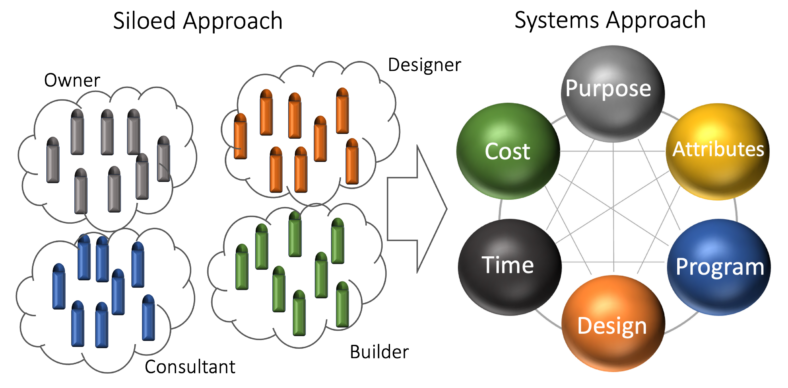
Figure 4 – From Siloed to a Systems Approach
When organizations and departments work as a true body, then they serve one another for the benefit of the whole system. The architect’s customer changes from the owner to those who use the architect’s product and service. Likewise, the foundations customer is the frame, the frames customer is the enclosure and so on. All parts work together as a system with an aim – the building occupant.
Point 10 – Eliminate slogans, exhortations, and targets – Lean Construction’s Target Value Delivery (TVD) has only driven up waste in time and costs. The leaner the project delivery, the fatter the budget, and the greater the waste. In cost plus contracting the greater the waste and billable hours, the greater the profit. We need to eliminate TVD
Significant progress and success can be made with the 1st tier design and building operations through the first 10 Deming point. As more 2nd and 3rd operations and/or partner organizations are added, points 11 to 14 roll out to attain greater waste removal, enjoyment, and reward.
____________________________________________________
End Notes:
1. Construction Industry Institute (CII) 2003 Study comparing construction and manufacturing productivity
2. Link to Barbara Berry article