Out of the Construction Crisis
_______________________________________________________________________________
The Problem
Buildings cost too much and take too long to build. The industry suffers from fragmented and archaic planning, design, and construction processes.
Today, every building component, process, technology, and person operates as a self-interested silo. Likewise, every department, organization, and building team operate as silos of silos. Tens of thousands of one-off, manual transactions and data exchanges place an enormous and unnecessary drag on building projects. The more complex the project, the greater the drag and uncertainty. The greater the uncertainty and risk, the greater the pressure to crank up the budget. This is construction’s state, despite the advancements of Integrated Project Deliver (IPD), BIM, lean construction, and a flood of new technologies. We don’t see this as a problem, because that’s all we’ve ever known. Plus, we haven’t seen an alternative. This problem is at the core of continued runaway construction costs.
As a result, for example, a $20 million dollar building project started in 2004 would now cost $31 million (a 52% increase) had construction cost escalated at the same rate as national inflation. But since, as shown in Figure 1, construction escalation has doubled national inflation that same project costs $44 million (120% increase)1.
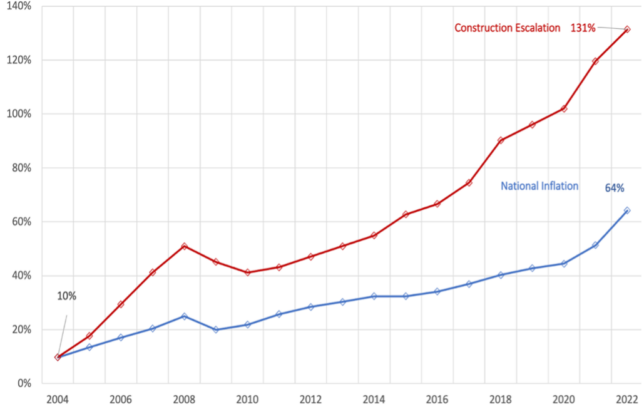
Figure 1 – Construction Escalation, National Inflation and the Prime Rate
Since construction wage rates and material costs have increased close to national inflation, how to we resolve the $13 million – the doubling of escalation? It’s not in material costs. It’s not in labor rates. It’s not in the direct labor rates (i.e. an electrician doesn’t pull wire at a lower rate today than yesteryear). It’s not in the visible fee percentage rate.
By and large the excess must be in the overhead and non-production, non-visible scope. Most of this scope can be referred to as construction support services (CSS). It’s in the CSS realm where we’ve seen the technology and explosion. It should be the opposite. Technology should increase production and reduce cost.
There is no end in sight for continued runaway costs as long as this situation persists. This is the problem that this “Out of the Construction Crisis” intends to solve. At the core, the crisis is due to fragmentation, misaligned contracting, and a lack of measurement. These, in turn are due to lack of standards and objective knowledge
“Lack of knowledge, that is the problem.” W. Edwards Deming.


There is no one to blame for this, because no one alive to today asked for the backward and fragmented state we find ourselves in. Even the most advanced builders – with dozens of new technical resources and applications – still operate as a collection of siloes with virtually no standards that enable data exchange by other than manual means. Even if a builder were to try to solve this – would it be possible? To do so would require them to recondition all the similarly standard-less and ill-informed data and information that comes from owners, planners, and designers. But the owners, planners and designers are similarly paralyzed for lack of industry data and information standards, structures, and processes.
As you will see, all these problems can all be solved.
End Note:
1 -Insert source.
“There is no substitute for knowledge.”
-W. Edwards Deming